Week 6 - Reflection on Crit
This week focused on critically evaluating my experiments so far and deciding how to refine or redirect my approach based on feedback and reflection. During the Week 6 critique, I shared my pencil sharpener prototype and received some valuable peer input around function, user interaction, and design intent. These conversations helped me realise the importance of pushing the project beyond basic function and toward more expressive, unpredictable behaviours that go a bit out of the box.
Using the "Refine or Pivot" guide, I’ve chosen to refine and build on my existing work by integrating Arduinos, however, I will also begin looking into more emerging technologies to begin preparing myself for my capstone project which I believe will be in the technology stream. This new direction will allow me to continue growing my electronics skills while looking into other possible domains that relate to my brief. Over the mid-semester break, I’ll begin to plan this next round of prototyping and research.
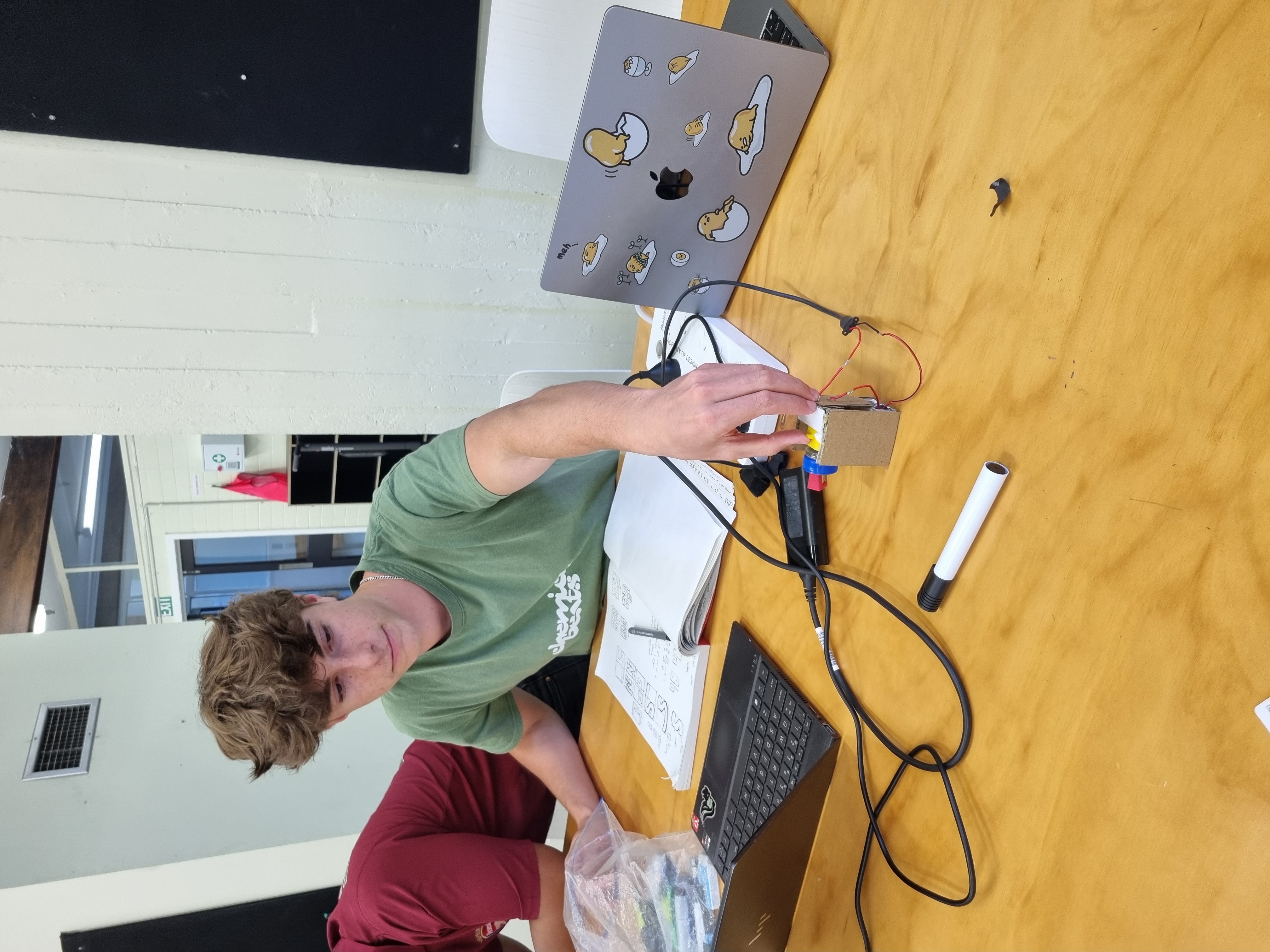
This week, I brought my functional prototype of an electronic pencil sharpener to the Week 6 critique. The sharpener used a simple circuit with a push-button switch to control a motor, and I brought a paper diagram to better visualise the function to my peers. My goal with this experiment was to build confidence in electronics and practice combining physical making with basic electronic functionality. While it was still in a rough stage, I was able to demonstrate its working functionality and talk through the decisions I made regarding inputs, outputs, and power sources, and then my plans to advance it. I'm hoping I'm able to get some guidance from my peers around my plan for the final 6 weeks, and where I could potentially take this.
During the critique, I presented both the physical prototype and a few sketches for where the experiment could develop next. I received a range of valuable feedback from my peers. Several people mentioned that they liked the push function a lot. They also mentioned they liked the idea to continue iterating on the sharpener, but not to go too crazy with inputs as it may complicate the mechanism.
Others encouraged me to lean into playful design elements. Suggestions included experimenting with code and Arduino to make the sharpener behave in unexpected or amusing ways, potentially framing it as a new kids toy which I thought was interesting. I was also prompted to think about how different demographics (ages) might interact with the object if it were designed with different base ideas like joy or novelty in mind.
Going into the critique, I felt somewhat confident in the technical execution of the prototype. I had accomplished what I set out to do: build a working electronic system from scratch and have the form and function work for random users. However, I was aware that the concept lacked a larger narrative or creative layer. I was nervous that it might be seen as too mechanical or straightforward for this stage of the course.
After receiving feedback, I felt more grounded and open to new directions. I was reassured that the work I’d done was strong in carrying out my goals, and I didn’t need to abandon it entirely—just rethink how I frame it. The suggestion to explore playfulness excited me a lot. It reminded me of childhood toys and devices that felt magical or alive, and it sparked excitement about giving a fairly boring object some life or character. I also felt a little unsure about how far I could push these experiments technically, as I’m still building fluency with coding and microcontrollers. But overall, I came out of the critique with some great motivation and some clear next steps.
The most useful part of the critique was the reminder that even a simple design can be bettered through behaviour and context. Rather than over-engineering the input system, my peers advised me to explore how customising the design could transform the user experience. This was a turning point. Up until now, I had been designing for basic functionality. Now, I’m thinking about the project from more of a design aspect and hopefully learning the necessary technical skills as a result.
A few challenges also became apparent over the break. The briefs were released to me for the Capstone project, and I believe I will be participating in the technology stream as I completed a brief in this area last year. This means I likely need to look over a range of further technologies to equip me with the skills for next semester. This means likely spending slightly less time on my electronics experiments or at least less focus on simple systems, and more how I'm going to apply them to a brief. I'm hoping through this I can effectively come up with some confidence behind what I am capable of in emerging technologies and ways it could be integrated with electronics and physical making.
Through this critique and reflection, I began to more deeply analyse how my positionality is shaping the direction of my work. My current identity as a learner of electronics—and my background in more visual or physical design—means I tend to approach problems with a mindset of technical mastery first, expression second. This has helped me in developing confidence with circuits, switches, and outputs, but it’s also prevented me from thinking about experimenting conceptually or emotionally.
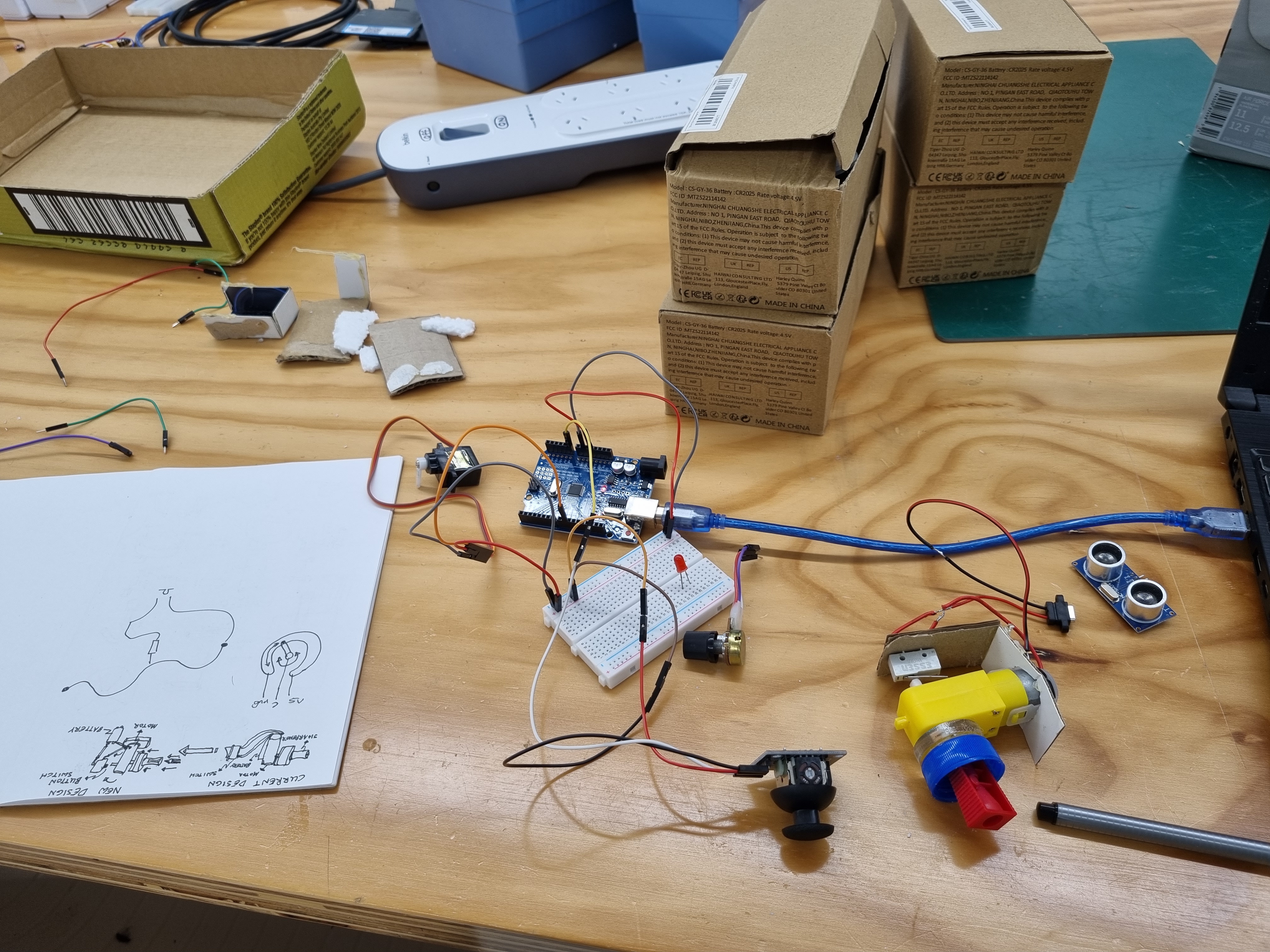
When my peers suggested changing the goal of the experiments from building something functional to turning it into a toy or giving it strange behaviours through Arduino code, I realised I had been unconsciously holding onto assumptions about what electronics “should” do: automate functions or perform with precision. I had avoided randomness, humour, or character, yet, these are exactly the kinds of ideas that could bridge the usefulness of a technical skillset with design thinking. Through this week to get familiar with a bit of the hardware and software I started to experiment with a few sensors in the Design lab to understand how the Arduino and Breadboards worked.
I’m now also starting to explore these experiments through an emerging technologies lens, especially as my Capstone brief is based in the technology stream. By beginning to research trends in smart devices, AI-driven behaviours, and reactive products, I can start to connect my electronics experiments with broader technological futures. As stated previously, my goal is to find intersections - how might electronics help to express new types of interaction with emerging tech, or evoke unexpected user responses?
Looking back, I see this week as a critical shift from building for function to building for behaviour and keeping my Design roots in mind. I now understand that even when learning new technical skills it can act as a platform for experimenting with expressive or reactive design. It doesn’t need to stay “just” one thing. It can laugh, light up, stutter, or ignore you depending on the conditions I program into it. The critique session helped me move beyond viewing electronics as merely technical and toward seeing them as experiential and relational.
Next week, I plan to iterate on the pencil sharpener prototype in two key ways. First, I’ll begin integrating an Arduino so the device can respond to different kinds of inputs beyond a simple button. I want to experiment with light sensors or motion sensors to create unexpected behaviours—like sharpening only in the dark, or reacting with random light patterns. This will push me to improve my coding and breadboarding skills while also exploring creatively.
Second, I will begin compiling a small research bank of emerging technologies that relate to my Capstone brief. I’ll look into speculative design case studies, unconventional IoT devices, and projects that use emerging tech. My goal is to start drawing thematic connections between these projects and my own experiments, gradually steering some of my experiments toward something that isn’t just functional, but conceptual.
This dual pathway—technical skill-building and conceptual expansion—will shape my next phase of prototyping. I’ll also revisit my positionality throughout the process, remaining aware of when I fall back on safe decisions and pushing myself to explore new terrain, even if it’s messy or unfinished.