Week 5 - The Pencil Sharpener
This week, I created an electrical pencil sharpener to develop my physical modeling and electronics skills in preparation for the Week 6 crit. The experiment allowed me to explore how motors can be integrated into everyday tools and gave me hands-on experience with wiring, laser cutting, soldering, component fitting, and functional testing. I also looked at the positionality checklist mentioned in class and reflected on this in each step to get a better understanding of how I think, my values, and how these may be affecting my experiments. Looking ahead, I plan to improve the sharpener’s form and incorporate Arduino's to broaden the inputs and outputs I may be able to get out of the pencil sharpener. In this process, I hope to continue using the creative side of my brain in coming up with unique experiment ideas in this area, while learning the technical skills that come with the Arduino (Code, wiring, breadboards etc.)
This week, I created my electrical pencil sharpener based on feedback from Week 5 and prepared it for critique. In the week 5 session I talked with my tutor Leo and my classmates about this plan to continue my electronics journey through the creation of the pencil sharpener and they loved it. Luke mentioned I should try focusing on the form of the sharpener as well as its function to continue developing my love for physical model making. I thought this was great because it will help me to think about the number of components I'm using and how I could be more efficient which is crucial in design.
I began by making the simple function of the sharpener through connecting the wires and sharpener to the motor to make the sharpener spin. This then lead to me adding a switch so it could be turned on and off. Finally I added a pressure switch mechanism where the sharpener could be operated by pressing the pencil into the sharpener making it more intuitive.
I’ve always been drawn to tools and hands-on making, likely because I grew up in a household where fixing things was part of everyday life. My comfort with electronics and building has shaped why I gravitate toward physical prototyping. That background influences not just what I choose to explore, but how confident I feel pushing technical boundaries.
Here's a bit of the making process:
I began this process by getting a hold of some of the components I needed. I found a wheel motor and removed the wheel which worked great as it could spin at a fast rate. I also used a switch, and a simple usb power bank at this time while I was trying to get down the simple functionality.
Through this process I had to solder together all the wires as seen on the left. I got a great tutorial from Steve from the design labs, and believe this will be a great skill to have through this model-making and electronics journey.
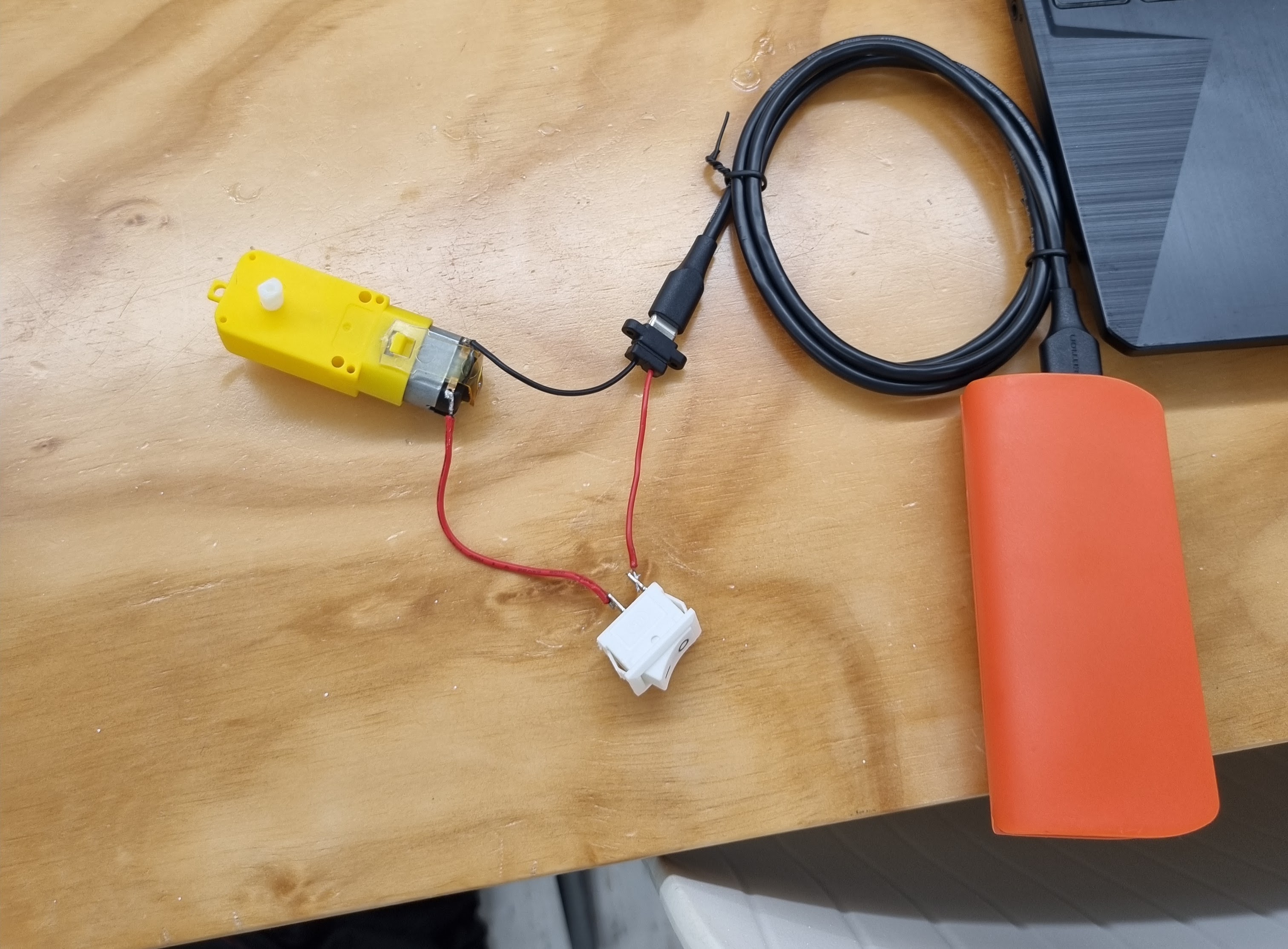
Here is an example of all of the components working. I initially ripped off a small piece of cardboard I could potentially glue a pencil sharpener to in order to see how it spun. While if the hole was more central, it would spin really nicely, I felt a bottle cap could allow me to easily glue the sharpener and would be a stronger material over time.

To attach the sharpener I talked with one of the Design lab technicians, and we decided to cut a circle out of acrylic and stick the bottle cap to this. We would then laser-cut a hole in the middle of this acrylic to attach to the motor. This was an awesome experience in another new skill in laser cutting. As recommended by technician Steve, I will continue to laser cut every couple of weeks or so to keep this skill fresh in my mind.
.jpg)
Here I managed to screw the bottle cap and glue it to the acrylic to create my main spinning mechanism. I'd also started to make the outlays to the structure of my sharpener. It spun really centrally without much imbalance which I was really happy with. At this point, I wanted to change the function to a pressure switch, so that the sharpener activated when a pencil was pressed into it.

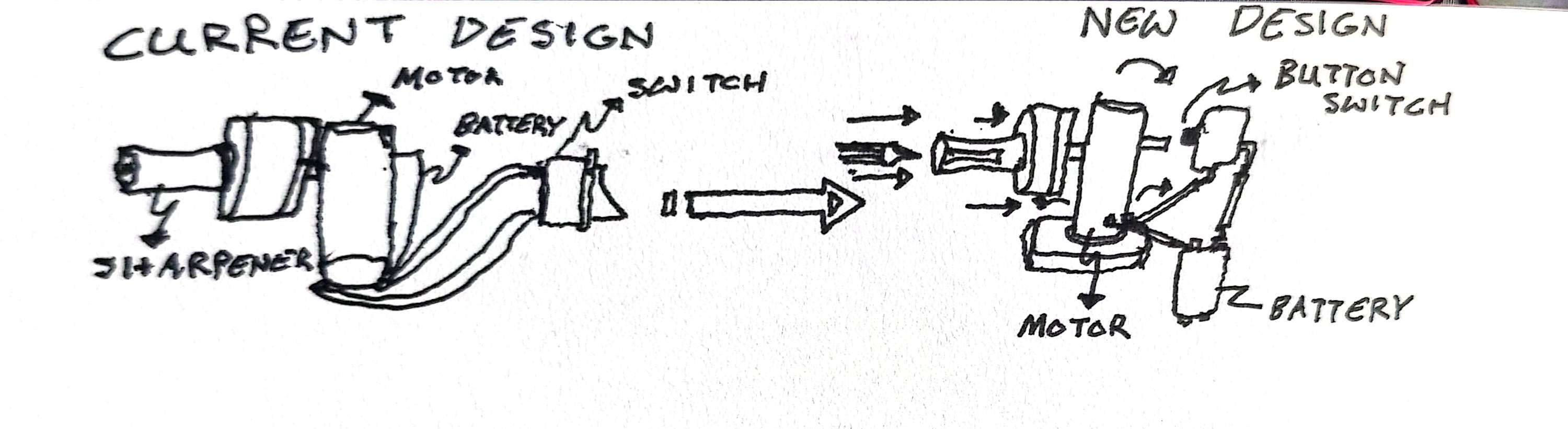
Here I designed how the new function might work so that when the pencil is pressed into the sharpener it activates and when it is pulled away it stops. I used a smaller battery and a mechanism that held onto the motor upright but had flex so it could lean back into the button when it is pressed, and sprung back when the pencil was pulled away.
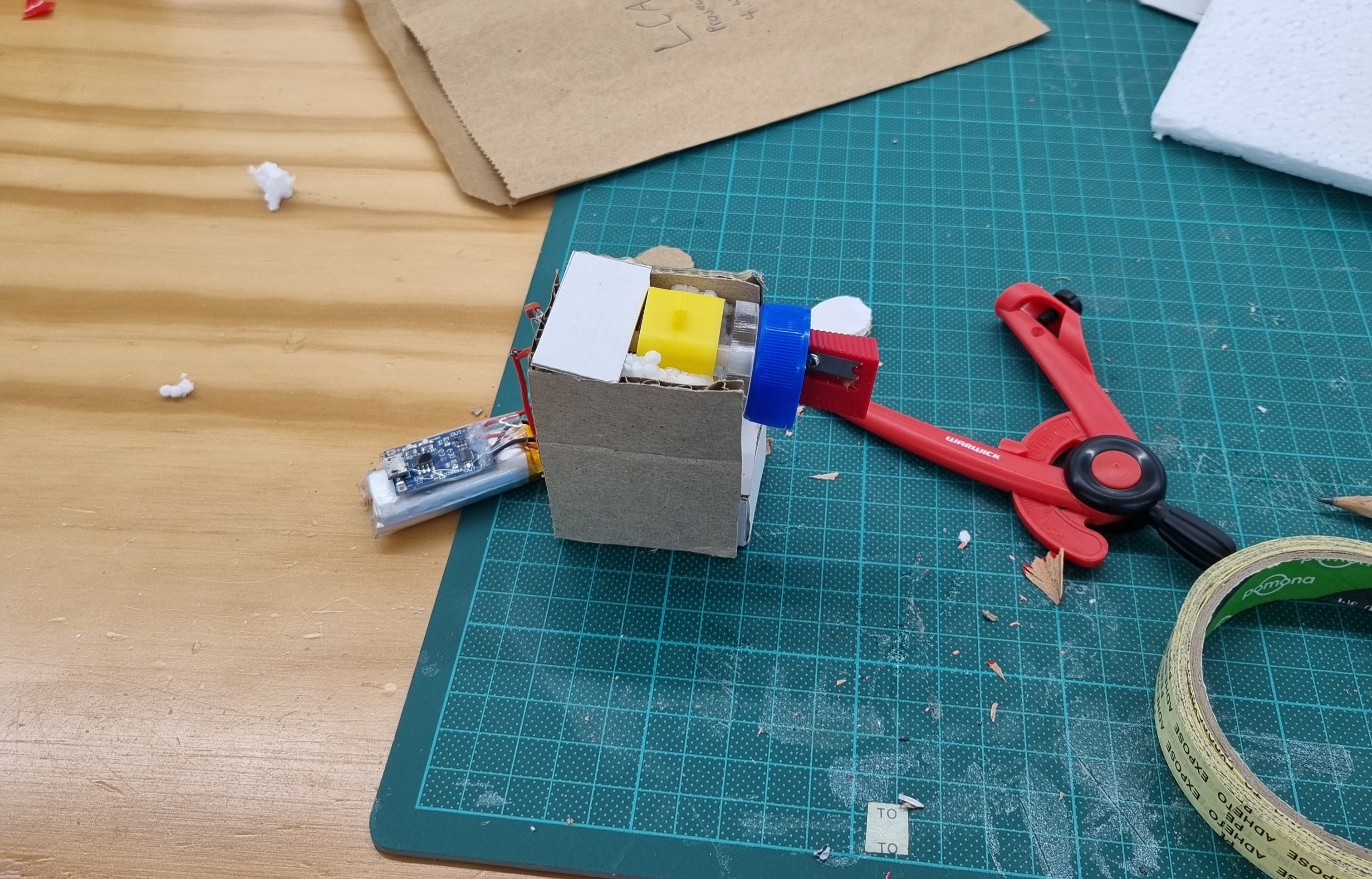
This resulted in my final first iteration of the pencil sharpener. It worked super well, apart from the motor slipping off the switch when it was pushed back. This was simply fixed with some polystyrene stuffed between the walls and the motors to hold it centrally. I hadn't yet built the outer shell of the sharpener so the wires and battery are hidden however I felt this would be enough for my crit session on Thursday.
The critique session helped me see that maintaining creativity as a designer along with gaining these technical skills is extemely important. My tutor Leo and classmate Luke encouraged me to push the boundaries of where this electric pencil sharpener could go while keeping user needs at the center in order to further my creativity in problem solving and human-centered skills as a Designer.
I felt this was demonstrated in the transition from a manual switch to a push switch in the final iteration shown. The change to this more convenient function created a number of problems I had to solve, from how the motor was going to make contact with the button, to how the button would be unpressed and spring back into place so it could be turned off. Fortunately glueing just half of the base that kept the motor upright allowed the motor to flex into the switch when pressure was placed on the sharpener - turning it on. Then when force was taken away the motor could spring back into place - turning it off. This was a super gratifying success in this process and I think opitimised the importance of learning these skills as a designer. As we often come to roadblocks or problems with our designs, these take creative thinking to overcome rather than just a technical skill.
Reflecting on this, I realised that at times as someone comfortable and interested in DIY tech, I can tend to interpret feedback more through a lens of function than user emotion or accessibility. I now see that I’ve been avoiding more inclusive perspectives when thinking from a technical perspective. This was an important wake-up call.
This week, I expanded my practical skills by learning how to use the laser cutter to create some materials to help connect the motor and sharpener, and I also experimented with installing push switches to make the device safer and more intuitive. I followed the advice of Steve from the Design Lab, who helped teach me laser cutting setups and basic electronics wiring, which helped me move from rough hand-built prototypes to more polished, repeatable forms. These resources directly shaped how I refined the effectiveness of the sharpener's function, and how I integrated a safer activation method.
For the next stage of development, as I previously stated, I plan to continue iterating on the pencil sharpener by experimenting with ways to make it function. My goal is to deepen my understanding of electronics by integrating more advanced components like Arduinos to control the device's operation under different commands. This will push me beyond simple circuits into programmable electronics, helping me grow my technical skillset while also challenging my assumptions about how everyday tools should behave.
I will come up with a more solid plan following my crit, however, my plan for now to achieve this is I will start by testing basic Arduino setups—using the Design Lab technicians to help me learn about the different sensors, motors, and randomised functions—and gradually get more complex as I gain confidence. I also plan to prototype multiple behaviours side-by-side to see how changes in coding and wiring affect user experience. Reflecting on positionality, I’ll stay aware of how my comfort with experimentation might differ from a typical user's expectations of a "normal" pencil sharpener, making sure that even playful or random behaviours are still understandable and meaningful. My aim for Week 8 is to have at least one Arduino-controlled sharpener prototype ready for critique, exploring a specific mode of interaction.