Week 10 - Final Sharpener Work Before Presentation
In my final week, I focused again on getting the wiring and a cardboard mold finished. After troubleshooting and refining the circuit, I successfully got the components functioning as intended. I also finally managed to create a cardboard mold, which should set me up to prepare for my presentation in week 12, and potentially finish a 3D printed product.
Week 10. Finally getting to the end of the semester. I've actually really enjoyed all the learning I've done over this course, and now it will almost be time to start articulating it through my presentation in Week 12. This week my goal is to finish a cardboard prototype of the sharpener keeping track of dimensions and pieces. Then I can solely focus on my presentation and reflection towards the end of the week and into week 12.
After soldering the copper tracks on the PCB back into place last week, it kind of feels like a thousand pieces taped back together, but I really don't have the time or energy to redo this. As long as it works, I'm happy.
I've decided to take a more structured approach to the building this time with a main wall I will stick all the wiring to, ensuring first they are in place and won't move around. Then I will enclose it when I know all the wiring is still working.
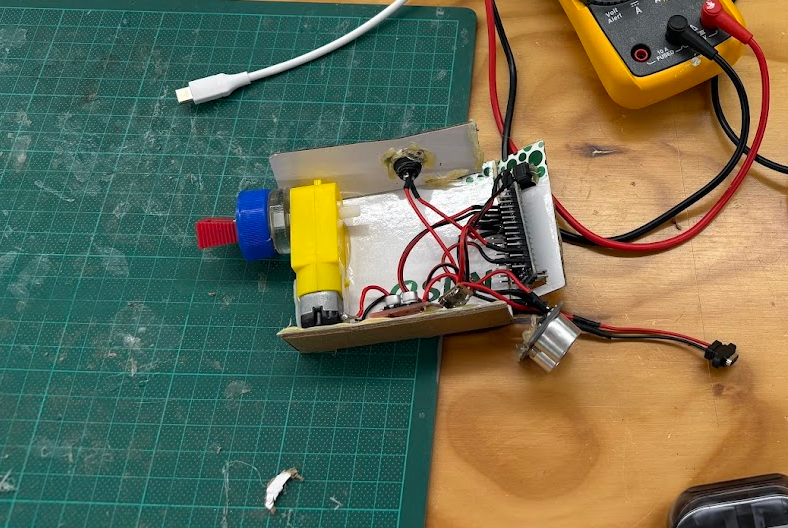
I got to work with this and everything was going to plan. I started with taping the motor to the wall and ensuring all the components were lined up correctly, then I glued the bottom platform to the motor, motor driver and PCB as seen above. Then finally I cut holes in the cardboard top and the back for the switch and button.
Throughout this process I made sure to continue using the multimeter (the tool I used in week 8) to ensure that all the wires and connections are receiving current throughout the circuit. This was really my pitfall in my past iterations through not testing that everything stayed connected as I began to move things around during the physical making. I would follow this up with an electrical test with power heading into the system ensuring the components all received the correct commands from the Arduino.
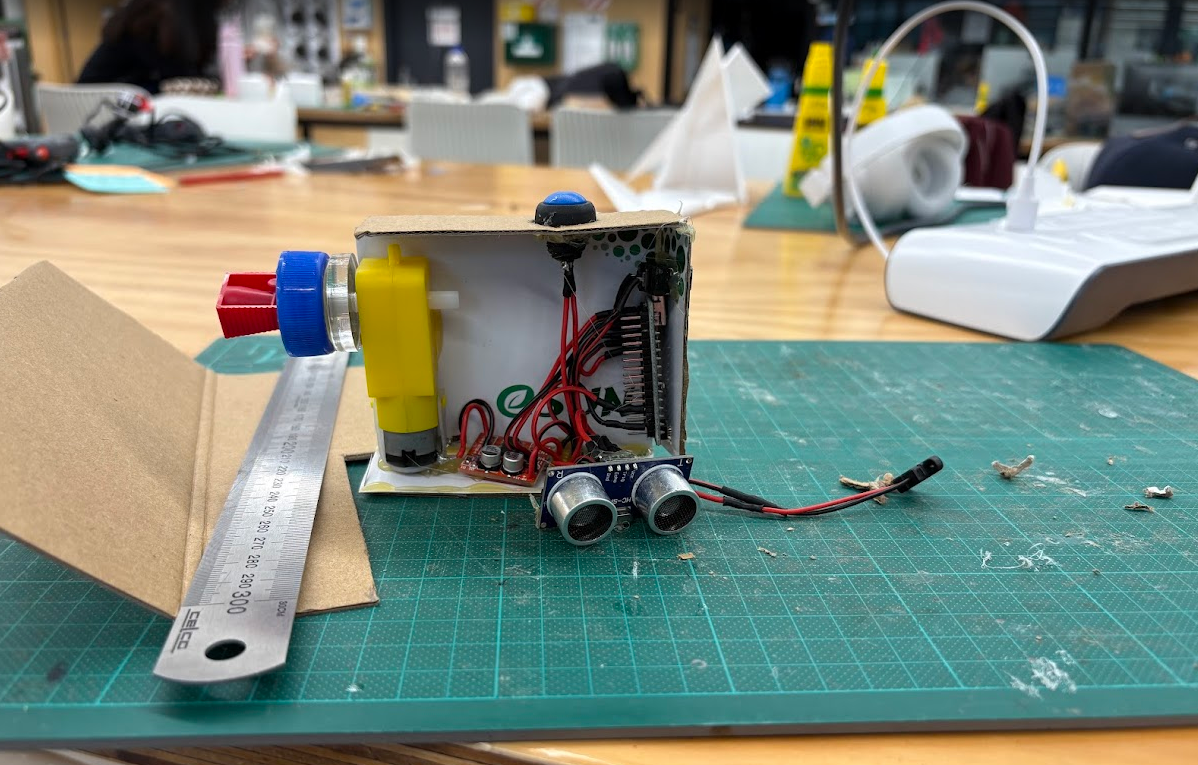
I was pretty happy with how it was coming along. After connecting all the walls of the cardboard model I decided to give it one more test with electricity before closing up the housing of the wiring, and.... nothing.
I couldn't believe it. I was so sure everything was connected through the many tests of the wiring I'd done up to that point. After frantically pressing buttons and flipping switches I knew something had to be wrong with one of the components.
This is because this time the Arduino was lighting up, meaning it was receiving power. My previous wiring issues were shorting my circuit meaning no power was passing through. With the help of Design Lab technician Aldo, we got the multi-meter out once again to check all of the connections.
We suspected it to be some solder that had leaked between positive and negative tracks, so we grabbed a knife and scored lines between both tracks ensuring there were no connections. This thankfully seemed to work as the motor began to rev once again.
At this point I knew it was time to close up the housing.
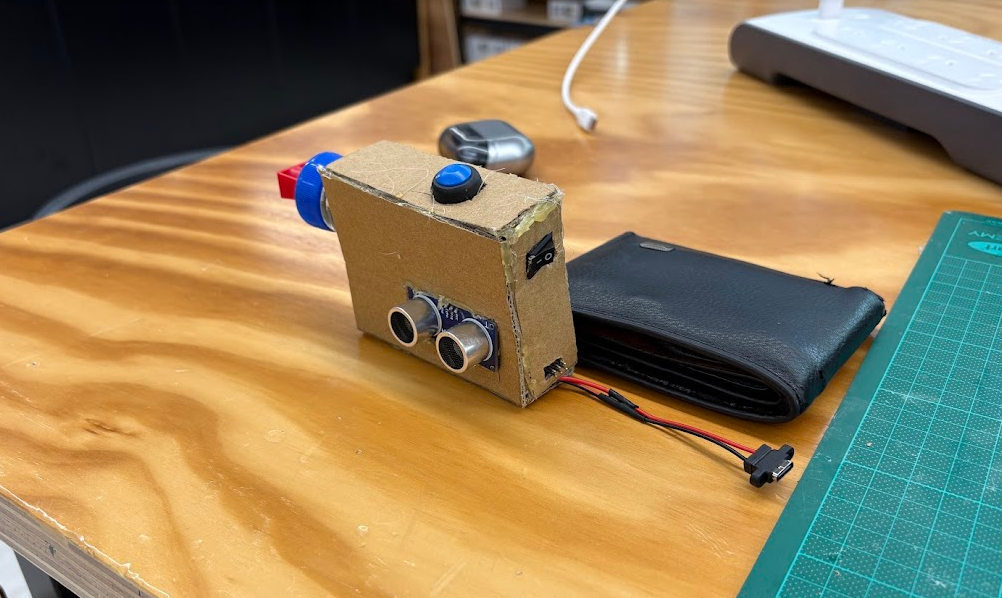
I was pretty happy overall with how it fit and its look. From here I would put one more layer over the top which hides the sharpener and creates a space below it where the shavings could fall into.
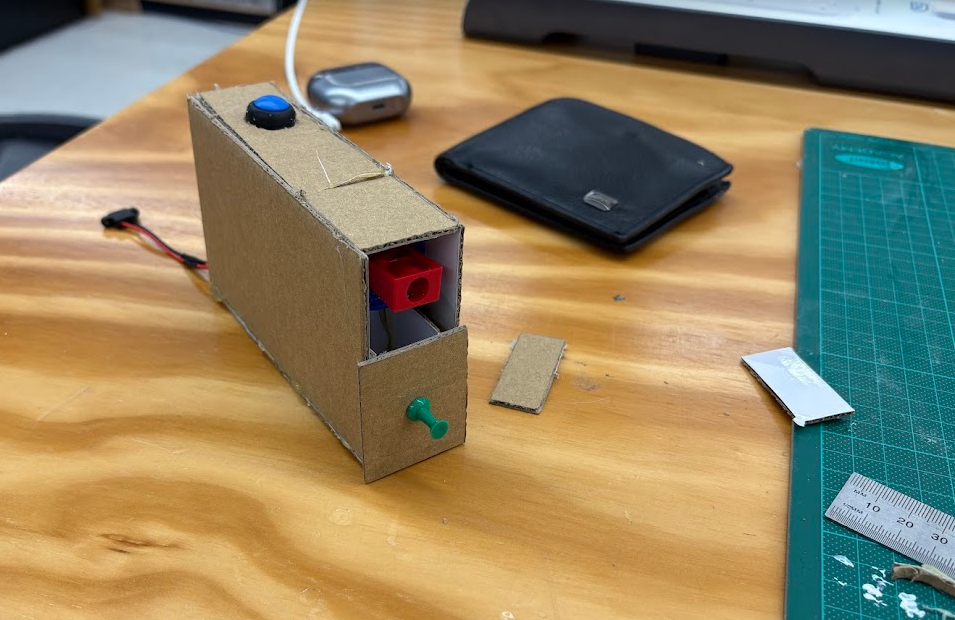
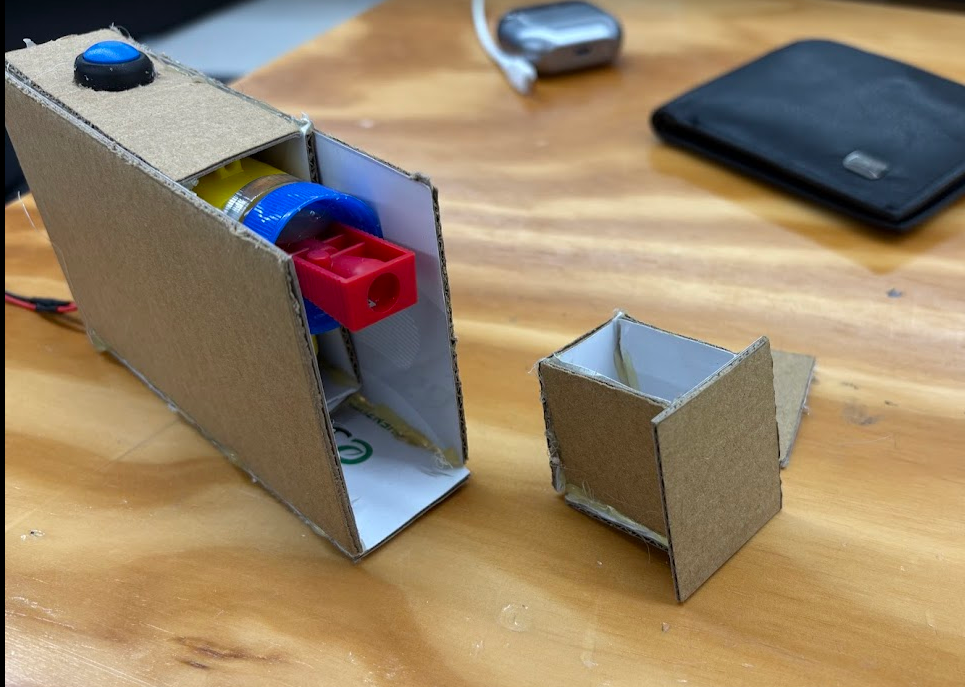
After finishing the cardboard pencil shavings holder, I simply used a pin so it can be pulled in and out.
All that was left now was to test it!


Well... we finally made some progress. After all the setbacks and rewiring from previous weeks, the cardboard mold prototype works. It was incredibly satisfying to see everything come together - both the electronics and the physical form - after so many frustrating attempts. Having the circuit actually function inside a properly fitted enclosure showed me how having fully functional prototypes can help elicit so much more feedback when you put it in a user's hand. As soon as I tried sharpening a pencil I realised how uncomfortable having the sensor on the right side was for someone right-handed as it meant I had to use my left. This is information I probably wouldn't have realised unless I had a full functioning circuit, and my task was to actually sharpen a pencil rather than emulate the process.
While it’s still rough and clearly a work-in-progress, seeing it all integrated was really awesome. It reminded me that iteration isn’t just about fixing what’s broken - it’s about steadily building toward something that feels coherent and usable. The process has also helped me think more intentionally about the interaction design and how users might engage with the object in different settings. I’m starting to feel more confident in my ability to move forward into refining materials and adding polish to my physical models in future iterations. It’s motivating to finally see real results, and I’m excited to not only maybe finish a 3D mold but continue to use these skills in iterating real design problems.
While building the housing for the circuit, in my own time I decided to look into a few resources on how professionals organise their wiring inside enclosures to get some ideas for my final 3D printed model. While plenty of the videos were more for electricians rather than designers and engineers I did find the below video to be quite helpful in giving me some reference.
Something else I found doing further research into this area is the importance of your electronic housing having a detachable point so you can access the wiring should anything go wrong. This was something I felt the effects of in the earlier weeks when I had to completely rebuild my cardboard molds when the circuit stopped working. This mistake likely would be a lot more costly if it happens with the 3D printed model!
Overall, this research will be something I get deeper into over the coming weeks. Keeping your wires organised and clean makes changes easy, and prevents damage from occuring.
From here it will be time to start making my presentation slides ensuring I cover each pivotal step in my semester and try to articulate it in a way that is chronological and understandable. I think I want to allow time for some questions or interactive activities with my group members to ensure they are engaged with the process, and maybe take away something themselves.
Regarding the electronics, I think from here while it won't be included in my courses, I want to design something new to solve a problem using these new skills. I think building something that's innovative will encourage me to think more critically about how circuits and Arduinos interact with physical modeling, and find creative ways of navigating different dead ends through multiple failing iterations.
Overall, I truly feel I've improved these skills massively over the semester and look forward to where this may take me in both my capstone and future.